
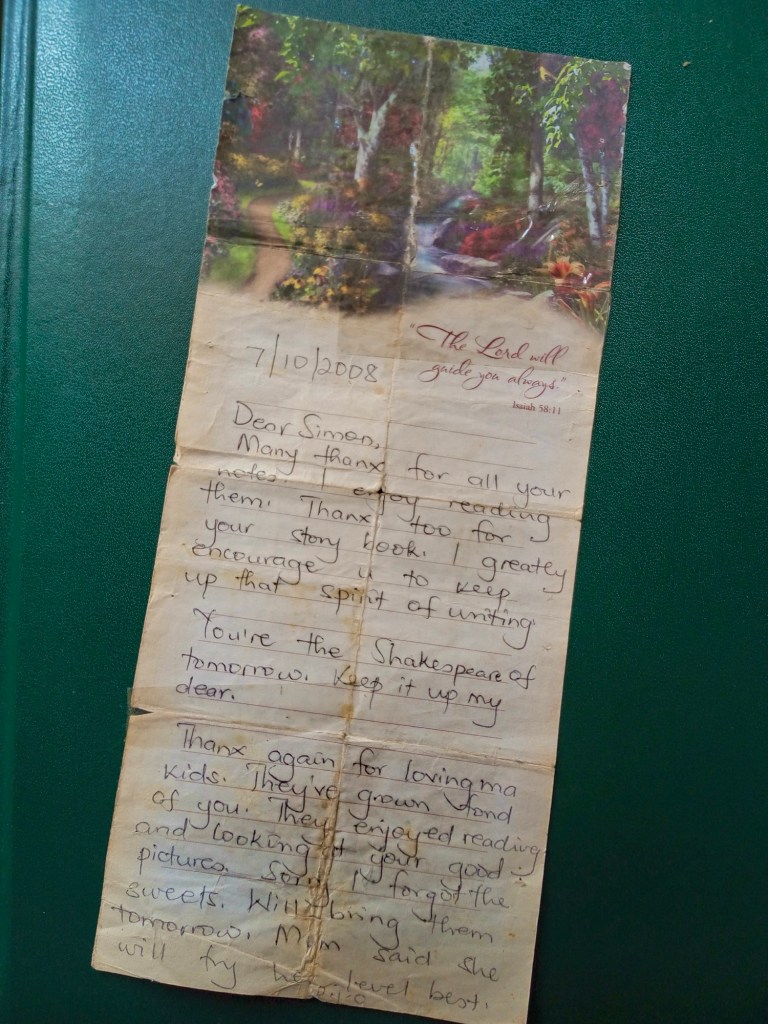
This was a note I received from my English teacher in primary seven. I’d just turned 11. I always rewrote fairy tales, and illustrated them, and she enjoyed reading them especially to her kids.
This was the first time I heard the word or name ‘Shakespeare.’ I couldn’t even spell the noun. It was later in secondary school that I heard of the awesome legend. I had heard of Romeo and Juliet but not together with William. Literature introduced him to me, and year after year, I grew to appreciate the wonder he was in the writing sphere.
I adopted the name for my journalism post at school. And it was quite a coincidence that my surname bore 11 letters as well.
That aside, the weight of what my teacher wrote has grown to be a ringing in my ear, and an identity. Years later, God made it known to me that He was intentional about using my teacher in that wise. He doesn’t need anyone’s permission to use them in regard to anyone’s destiny.
And that’s what I’d want to point out for you today. God will not always say a destiny-defining thing to you in a very extraordinary way. I’ve grown fond of Him saying things casually. Not that it will be a light thing. But no wonder He says ‘let he who has ears hear…’ This implies that it’s possible for God to say something, and it goes unnoticed.
You must really HEAR what He is saying. You must become more and more accustomed to His voice, that when He calls you like He did Samuel, you won’t confuse His voice for someone else’s. In fact, you should be able to tell when He ‘possesses’ someone and makes use of their tongue for a second or minutes.
We are used to prophecies, and there is a way we prepare for them, probably because they seem unorthodox moments in time. Sometimes, they come during or after prayer, or in-between that ritual. But how about those moments … when you were not fasting, or deep in prayer, and yet God is speaking!
He will speak when Moses goes up for forty days consecrated. He will still speak when He finds Mary doing the dishes, to announce to her that she’ll be conceive the son of God!
If we are not on our feet, we might miss God. We shouldn’t think He comes in an earthquake, or a burning bush only! To one He will choose one way, and to someone else — another.
Times He spoke clearly to me amidst worship. Other times dreams. Most times He’s come direct as I read the word. Others … when I slept. Then I hear Him say words … and then I awake to involve in the chat.
One time, a lecturer had just trashed my work. His senior came and applauded the same work. She was a doctor of philosophy in architecture, and she said “You are going to be A STAR!”
I wonder what came over her! — Wait, I do! She said that in 2017, and that was when I began noticing God use even the most ordinary of men to speak Kairos words.
The same lady, while I presented in 2023, randomly said, “Your passion will take you sooo far!” I had to act normal, but deep down, I sensed when God entered the chat, and decreed words that I’d anchor to, when situations around seem contrary to His word.
Bottom line is: you must mature to note when God speaks in the ordinary. In ways, you least expect. He can intercept the barber’s jokes. He can use a toddler to speak to you. He can use a Tv advert or commercial. He can use a song which’s necessarily not written by a christian! He can use the clouds! He can use a donkey as well!
Discerning His voice here may not come as a gift; it comes with learning God, just like you grow to know a friend’s likings, distastes, character and whatever entails them. With God you grow fonder of Him, so that when He speaks — even if tones don’t change — you can identify the words He has coined.
I pray that you are so tuned to Him when He seeks to pass you a message. If you feel you have missed Him, learn how you did, so that next time you don’t.
•
I Kings 19:11-13 “Then He said, “Go out, and stand on the mountain before the Lord.” And behold, the Lord passed by, and a great and strong wind tore into the mountains and broke the rocks in pieces before the Lord, but the Lord was not in the wind; and after the wind an earthquake, but the Lord was not in the earthquake; and after the earthquake a fire, but the Lord was not in the fire; and after the fire a still small voice. So it was, when Elijah heard it, that he wrapped his face in his mantle and went out and stood in the entrance of the cave. Suddenly a voice came to him, and said, “What are you doing here, Elijah?””
 Biggie's Big Blogs